
Pretty Hearts, Ugly Truths
Powerful art. Uncomfortable truths. How an Australian installation is challenging the everyday language that excuses violence against women
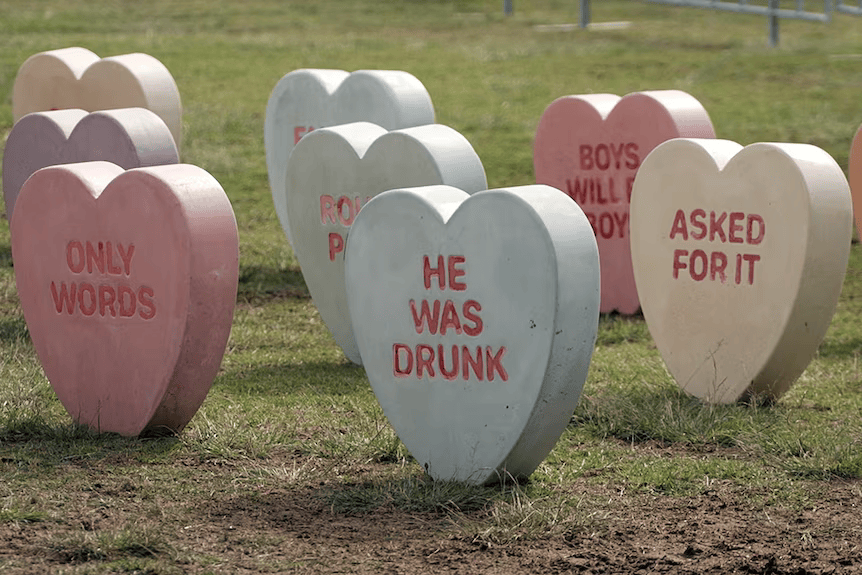
At Sydney’s Sculpture by the Sea, an installation of pastel-coloured concrete hearts confronts the everyday language used to excuse domestic abuse, turning familiar words into a powerful call for accountability.
At first glance, they resemble oversized love-heart sweets. Pastel colours, familiar shapes and seemingly harmless phrases. But behind the playful appearance of Sweethearts lies a confronting message about violence against women and the attitudes that allow it to continue.
Created by Australian artists Philippa Lysaght and Omi McCurdie, the installation forms part of Sydney’s 30th anniversary Sculpture by the Sea exhibition, transforming a stretch of the Bondi coastline into a public space for reflection, remembrance and accountability.
Each hand-polished concrete heart represents a woman killed by a current or former partner in Australia this year. What began as a plan for 52 hearts had to expand as the reported death toll continued to rise. At the time of the artists’ interview with ABC News, Lysaght said the figure had reached 56.
When Everyday Words Become Part of the Problem
Phrases etched into people's hearts are ones many will recognise. Expressions such as “boys will be boys” appear innocent in isolation, but can form part of a wider culture that minimises harmful behaviour, shifts responsibility and excuses abuse.
Lysaght, whose background is in advocacy, consulted women’s organisations and shelters to identify the language used to dismiss or downplay violence. The result is an installation that asks visitors to consider not only the lives lost, but the attitudes that can contribute to a culture of silence.
It challenges an uncomfortable reality: violence against women does not exist in isolation from the language, beliefs and behaviours that surround it. When controlling behaviour is mistaken for affection, aggression dismissed as frustration or responsibility shifted away from perpetrators, harmful attitudes can become normalised.
These words matter. And so does our willingness to challenge them.
Art Beyond the Gallery
There is something particularly powerful about placing Sweethearts in a public space. Rather than asking audiences to enter a gallery or seek out a conversation about domestic abuse, the installation brings that conversation into everyday life.
Thousands of people walking along Sydney’s coastline will encounter the work, perhaps unexpectedly, and be invited to reflect on an issue that too often remains hidden behind closed doors.
The contrast between the colourful hearts and their meaning is deliberate. What initially appears playful becomes increasingly difficult to ignore. That's where art becomes a powerful form of advocacy.
It can interrupt familiar surroundings, challenge assumptions and communicate experiences that statistics alone cannot fully capture.
From Awareness to Accountability
At Make Yourself Heard, we believe lived experience, creativity and collective action all have a role in challenging the systems and cultures that enable harm.
Sweethearts is a reminder that preventing violence against women requires more than responding after an offence has occurred. It also means questioning the language we use, the behaviours we excuse and the attitudes we allow to go unchallenged. Awareness matters, but awareness alone is not enough.
Meaningful change requires education, prevention, properly funded support services and institutions willing to hold perpetrators accountable.
The installation also demonstrates the importance of collaboration between artists, advocates and specialist organisations. Following its planned appearance at Sculpture by the Sea in Cottesloe, Western Australia, the hearts will be sold, with proceeds supporting Women’s Community Shelters.
The project therefore extends beyond the exhibition itself, connecting public awareness with practical support.
Making Space for Difficult Conversations
Art cannot, on its own, end violence against women. But it can create space for conversations that society too often avoids. It can make familiar excuses uncomfortable. It can challenge indifference. And it can remind us that behind every statistic is a person whose life mattered.
For Make Yourself Heard, Sweethearts represents the potential of art to bring advocacy into public view, encouraging people not simply to look, but to question what they see.
Because challenging violence against women is not only about recognising its most extreme consequences. It is also about confronting the everyday attitudes that allow harm to be minimised long before those consequences occur.