Extend the Protection
Why survivors without shared children are calling for the same
safeguards in family court

A rule that protects some survivors - but leaves thousands behind.
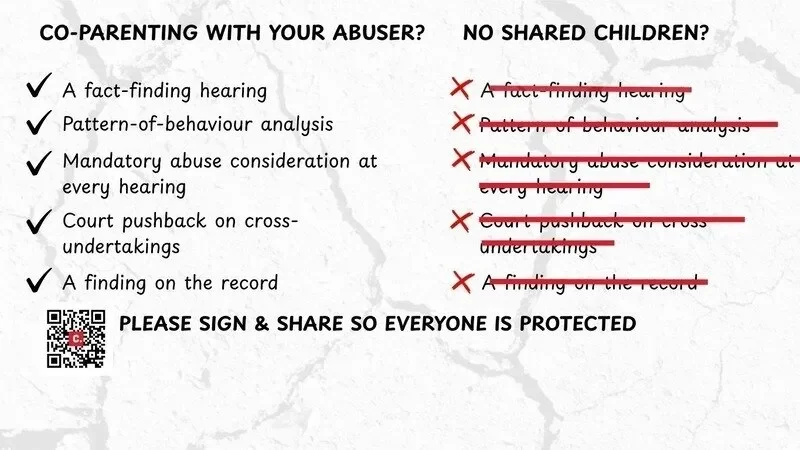
When domestic abuse survivors go to family court, the protections available can depend on whether they share children with the person who abused them.
Practice Direction 12J (PD12J) helps courts recognise patterns of domestic abuse in child arrangement cases, ensuring abuse is viewed in its full context rather than as a series of isolated incidents. But survivors applying for non-molestation orders without shared children often fall outside these protections.
The petition calls on the new President of the Family Division, Sir Stephen Cobb, who helped create PD12J, to extend those same safeguards to all domestic abuse survivors.
It also highlights a dynamic many survivors will recognise: allegations of abuse being met with counter-allegations, creating a narrative that both parties are equally responsible. This can reflect what is commonly known as DARVO - Deny, Attack, Reverse Victim and Offender - where the focus shifts away from the abuse itself and onto the person seeking protection. Supporters of the petition argue that stronger fact-finding and a greater focus on patterns of behaviour could help courts better identify and respond to these tactics.
Campaigners say that survivors without shared children can face weaker procedures, fewer requirements for fact-finding, and a greater risk that coercive control and post-separation abuse are overlooked.
At its heart, this is a simple ask: abuse should be recognised as a pattern of behaviour, regardless of whether children are involved.