
The Justice Reform Meeting My WHOOP Mistook for Ice Hockey
On Friday, a meeting with the Lord Chancellor about the Courts and Tribunals Bill, the Crown Court backlog and the future of jury trials sent my heart rate soaring - and left me questioning what advocacy is doing to my body
By Jade Blue

My partner asked me a question afterwards that has stayed with me: “Is this stress actually good for you?” Closely followed by the harder one: why do you keep doing this?
On Friday, I sat in a meeting with the Lord Chancellor discussing the Courts and Tribunals Bill and the future of our criminal courts.
For the first thirty minutes, I mostly listened. I watched the body language around the room. I listened to the tone and the language being used. I tried to understand where the Government now sees this going.
And slowly, I could feel something changing in me. Because from where I was sitting, victims felt like an afterthought. The Bill includes positive measures, and I don’t want to lose sight of that. It includes changes around special measures and evidence in sexual offence cases, alongside wider reforms to the criminal courts.
But I came away incredibly disappointed by what felt like a significant pivot from the scale of reform originally discussed - particularly around structural changes intended to reduce pressure on the Crown Court. That pivot has since been confirmed publicly. The Government has scrapped the proposed Crown Court Bench Division, which would have allowed some cases to be heard by a judge alone rather than a jury.
For me, that is a significant loss from the original reform package. This was not an idea plucked out of thin air. It followed serious work by Sir Brian Leveson examining how our criminal courts could respond to an unprecedented backlog. Other countries’ justice systems also operate different models of judicial decision-making. The proposal deserved scrutiny, certainly. But I also believe it deserved the opportunity to be tested.
That matters when the latest official figures show 80,829 open Crown Court cases. By the end of June, almost 24,000 cases had been open for a year or more. Sexual offences accounted for one in five open cases. Those numbers aren’t abstract to me.
Behind them are people arranging their lives around court dates. People trying to parent, work, recover and somehow carry on while a case hangs over them. Victims and witnesses waiting months and years for an ending they cannot control. Life in limbo. And that is why I found Friday so difficult.
Why not pilot it?
There has been sustained opposition to the proposed restrictions on jury trials, including from the Criminal Bar Association, which has said it remains fundamentally opposed. Those concerns deserve to be heard and scrutinised. But I still cannot quite fathom why the response to disagreement has to become an all-or-nothing choice. If there are genuine concerns about a major reform, why not pilot it?
Choose appropriate areas. Establish safeguards. Include a sunset clause so the reform automatically expires after a defined period unless there is evidence and a decision to continue it. Measure what happens to waiting times, outcomes, and the experiences of victims and defendants.
Test whether it helps tackle the backlog. Test how it functions in practice. Test what it might tell us about the longer-term future of our criminal courts. Adapt it if necessary. Stop it if it does not work. Expand it if it does. That isn’t radical for its own sake. It is evidence-led reform.
I’ve seen it work.
The Early Victims’ Right to Review scheme began as a pilot in the West Midlands in 2025. It expanded to further CPS areas following positive feedback and, in July this year, was rolled out nationally.
Open Justice For All campaigned around access to sentencing remarks. A 12-month Ministry of Justice pilot initially provided free sentencing remarks to victims of rape and serious sexual offences; that principle has since been extended in legislation so that victims whose cases are heard in the Crown Court can request relevant sentencing remarks free of charge.
Pilot. Measure. Learn. Expand. To me, that’s common sense.
What frustrated me on Friday - and what has since been confirmed - was that one of the most consequential parts of the original reform package was being abandoned without first creating the opportunity to test its impact properly.
The Government’s own impact assessment estimated that the structural reform package as a whole could reduce incoming demand on Crown Court time by almost 20%. That figure relates to the package rather than any single proposal, but it shows the scale of what was originally being contemplated.
When the system is carrying more than 80,000 open Crown Court cases, we should at least be willing to test substantial change rather than assume the existing architecture must remain largely untouched. The world changes. Society changes. Justice systems can change too.
Tradition matters. Safeguards matter. Fair trials matter. But so does asking whether structures designed for another era still deliver justice effectively today.
Then my body joined the meeting
At around the thirty-minute mark, I stopped simply observing the meeting and started feeling it. My palms were sweating. My heartbeat was racing. I could feel the anxiety, anger, frustration and disappointment building. I was furious at what I saw as a missed opportunity. Not because I expect every reform I support to happen. Not because people shouldn’t challenge proposals. And certainly not because enormous changes to criminal justice should be rushed through without scrutiny.
I was frustrated because the system plainly isn’t working as it should, yet meaningful reform can easily get consumed by institutional battles while the people waiting inside that system remain in the background. Victims get mentioned constantly. But sometimes I wonder how much power their experience actually carries when the biggest decisions are being made.
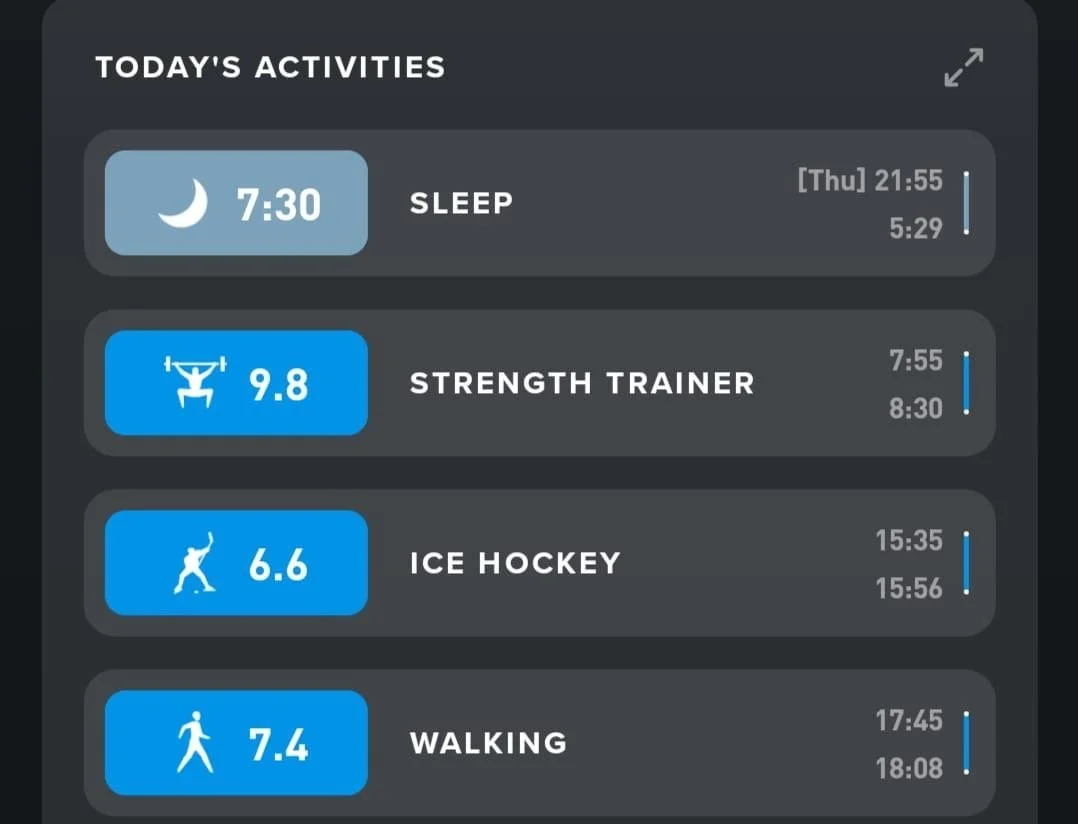
Later that evening, I opened my WHOOP. For around the final twenty minutes of the meeting, it had registered an activity. Ice hockey. I was sitting in a chair.
Yet my heart rate and physiological strain apparently convinced my fitness tracker that I was playing a sport rather than listening to a discussion about justice policy. I laughed when I saw it because, objectively, it is ridiculous.
Then I thought about what my partner had asked me. Is this stress actually good for you? Probably not. And then the other question: why do you keep doing it?
Because I’ve experienced what happens when the justice system gets something badly wrong. Because I’ve met too many people whose lives have been put on hold by it. Because I’ve also seen that change is possible - sometimes through something as simple and sensible as trying an idea, measuring it and being willing to learn.
That doesn’t mean advocacy comes without a cost. Friday gave me a strangely measurable reminder of that. I spent an hour talking and listening to discussions about courts, backlogs, victims and reform. My body thought I was playing ice hockey.
Sometimes advocacy doesn’t just take your time. Sometimes your body keeps the minutes too.